
Healthcare software by people who have shipped healthcare software.
Patient apps, lab logistics, secure results. We built all three for our own platform, Viora. Here is what that means for yours.
Domain knowledge from day one
We built and run a live product in this space. No learning-curve tax billed to your project.
In production — not a prototype
The edge cases our platform hit are already solved. We bring the fixes, not the question marks.
Full code handoff, no lock-in
You own the codebase, the infrastructure, and the IP. No proprietary black box, no exit fee.
Diagnostics is moving out of the clinic and into the home. Patients expect lab work the way they expect groceries: booked on a phone, tracked live, results delivered digitally. Most labs still run on call centres, paper requisitions, and PDF reports, and the gap between those two realities is where patients are lost.
The Real Challenges
Problems that quietly sink projects in this space — scoped before we shipped our own product.
CLIA certification and HIPAA-grade results handling
at-home draws still need a CLIA certificate, and lab results are PHI that must be safeguarded in storage, transmission, and in-app access.
Mobile phlebotomist supply and routing
revenue depends on routing a thin, licensed workforce across a city without dead miles, or slots stay slow and cancellations pile up.
Chain-of-custody and specimen integrity
temperature, labeling, and timely lab drop-off between the home draw and the partner lab is an audit-grade liability, not a UX nicety.
State-by-state licensure
phlebotomy scope-of-practice and mobile-draw rules differ per state, so a single national rollout becomes per-market compliance work.
What We Can Build
Custom software for Healthcare clients — scoped on a discovery call, built in sprints.
Patient booking & results apps
Patient-facing scheduling and secure in-app results.
Phlebotomist dispatch & live tracking
Field dispatch with real-time location for patients and ops.
Secure results delivery
Biometric access and audit-ready data handling.
Operator dashboards
Control rooms for labs, clinics, and hospitals.
Integrations
Connections into existing lab and records systems.
Our Stack Here
Not a generic stack — the specific tooling Healthcare software lives or dies on.
The Proof
We did not learn this on your budget.
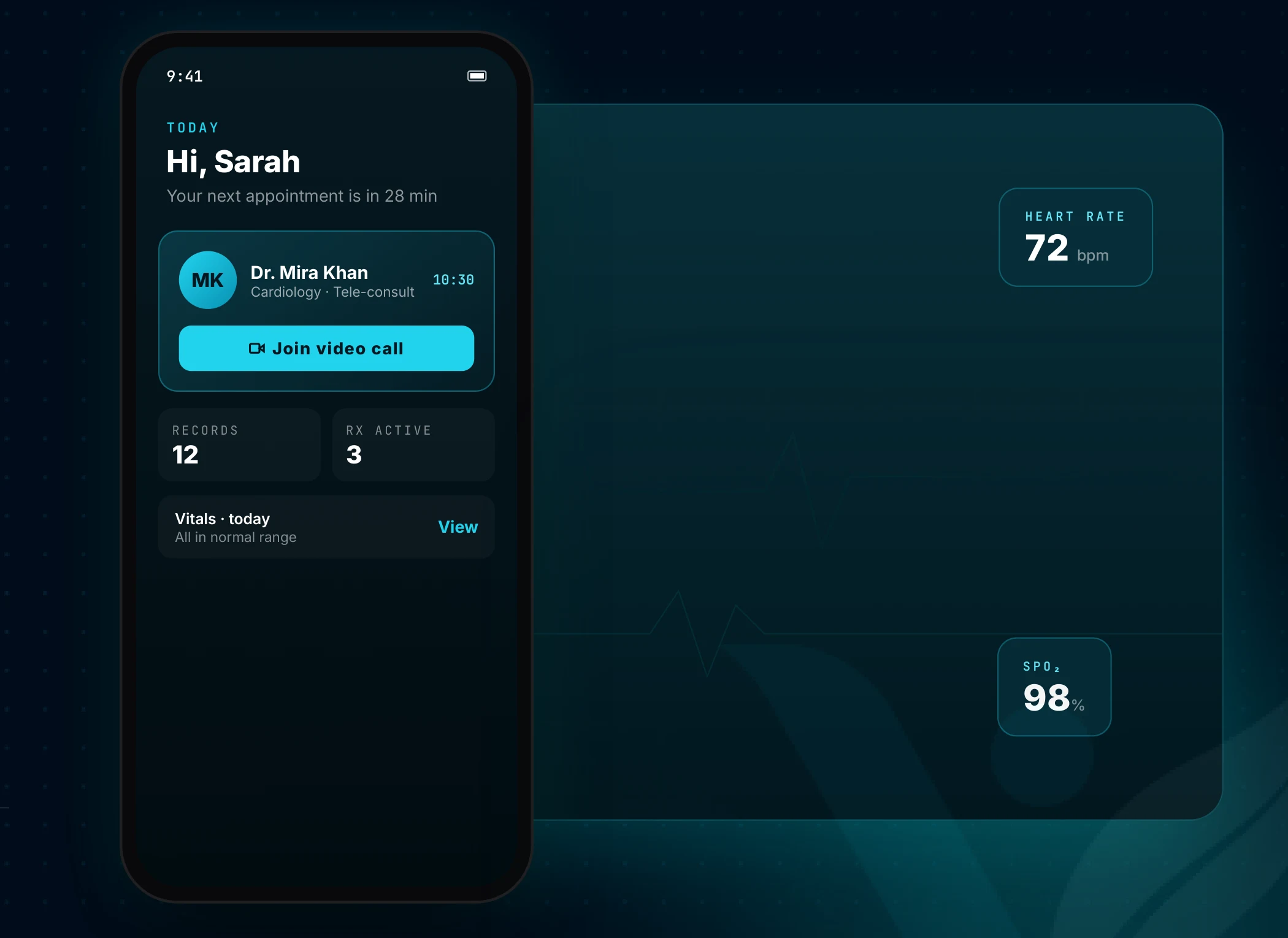
Our own Healthcare platform — built, shipped, and running.
Our own home-healthcare platform. Patients schedule lab tests to their doorstep, track the phlebotomist on a live map, verify them with a QR code, and receive results in-app behind biometric authentication.
Explore VioraExpertise Level
We have shipped and operate a live healthcare product, including consent flows, role-based access, and audit-ready data handling. We design for healthcare-grade privacy from the first sprint, not as a retrofit.
Who This Is For
Clinics that want home-based services without new buildings.
Hospitals extending care past their walls.
Diagnostic labs replacing manual dispatch.
Common Questions
Things clients ask before the first discovery call.
QDo you have HIPAA experience?
Yes. We built Viora under HIPAA constraints from the start: BAA-covered cloud infrastructure, field-level PHI encryption, role-based access control, biometric result delivery, and audit logging on every record touch. We know where the compliance landmines are because we have already stepped on them.
QCan you integrate with our existing lab or EHR system?
We have worked with HL7 FHIR and lab interface engines. Most integrations need a discovery call to map the specific API surface — what protocols the lab exposes, whether there is a sandbox environment, and what the result payload looks like. We will tell you what is realistic in the first week.
QHow long does a patient booking app take to build?
A fully functional MVP — patient scheduling, confirmation, live phlebotomist tracking, and basic results delivery — typically takes 10 to 14 weeks from a scoped discovery. Complexity grows with biometric auth, third-party lab API depth, and per-state compliance requirements. We scope those separately so there are no surprises.
QWhat happens after launch?
We offer post-launch support retainers. Most clients keep us on for the first 60 days at minimum — covering bug fixes, performance tuning, and load testing at real traffic. After that, you can take the codebase in-house with full documentation or continue on a retainer. You own the code either way.
Insights
More on building for Healthcare